
Cuyahoga County Release Meanings
A release record is a custody record. It tells how one booking or correctional term ended or changed. A court docket is different. It shows the judge's legal action, such as bond, dismissal, sentence, jail-time credit, conveyance, or community control. A supervision record then describes control after confinement. A complete account of Cuyahoga County released inmates often needs two of these records because one office does not own the full chain.
“Released” can mean return to the community after bond, recognizance, time served, dismissal, or sentence completion. It can also describe release from prison to parole or post-release control. By contrast, a transfer to ODRC, another jail, a community correctional facility, or immigration custody is not community release. Death is a custody departure but must not be described as an ordinary release. The exact release code and destination matter.
| Release or departure | Meaning | Next record |
|---|---|---|
| Bond or recognizance | Custody conditions in that case were met; the case remains open. | Sheriff release entry and court docket |
| Time served or sentence completion | The ordered jail term or credit was satisfied. | Release entry and sentencing journal entry |
| Dismissal | A charge or case ended, subject to any other hold. | Court entry plus jail release record |
| Parole or post-release control | Prison confinement ended while state supervision continues. | ODRC and APA record |
| Transfer | Custody moved to another agency or placement. | Movement entry and receiving system |
| ICE hold | A local departure may become immigration custody. | Sheriff destination and ICE locator |
Cuyahoga County Release Record Fields
The best Cuyahoga County release record connects a unique booking with the event and destination. The Sheriff's system may preserve that information in a jail card, booking record, movement history, release log, or commitment and release form. The county does not publish one required form name. A request should describe the existing information needed instead of asserting that a particular local document must exist.
Ask for identity fields only to separate the correct person. Then ask for authority, time, type, and destination. A release reason may be coded. If so, request the existing code key or data dictionary. Court and custody times may differ: a judge can sign an order, the Clerk can journalize it later, bond can be accepted, and the jail can finish hold checks at another time.
| Field | What it shows |
|---|---|
| Booked name and aliases | The identity used for the jail event. |
| Booking or inmate number | The unique link to that custody episode. |
| Booking date and time | When the local custody record began. |
| Arresting or committing agency | Which authority brought the person into custody. |
| Charges and case numbers | The court matters linked to the booking. |
| Release date and time | When the release or movement was recorded. |
| Release type or code | Bond, time served, transfer, or another recorded reason. |
| Destination or receiving agency | Whether the person entered another custody system. |
Note: A docket showing bond posted does not prove that the jail completed processing or cleared every warrant, case, and hold.
Request Cuyahoga County Release Records
The official Cuyahoga County public-record portal routes a request to the Sheriff. Ohio does not require special words or a mandatory request form. A narrow description usually produces a clearer search. Identify the full name, known aliases, date of birth when needed to distinguish identity, booking or case number, and a short date range. Ask for electronic copies and name the release or movement fields sought.
- Describe an existing booking, release, movement, or jail record. Do not ask the office to create a new report or answer broad questions.
- List the booking and release date and time, agency, case, bond or hold fields, release reason, and destination needed.
- Request the booking photograph separately if it is needed for identification and is releasable.
- Ask for nonexempt portions and the legal authority for each withheld or redacted part.
- If the record is gone, ask which current retention-series entry governed it.
Inspection is free. County rules allow paper copy charges up to $0.03 per page, waived when the total is below $1. County-provided storage media may cost $1 per gigabyte, and actual delivery costs can apply. Electronic delivery is generally not charged except for allowed printing needed for redaction. Advance payment may be required. Ohio law calls for prompt inspection and copies within a reasonable time. It does not set one fixed response deadline for all requests.
The successful manifest capture of the county request form and fee notice shows the official request entry point.
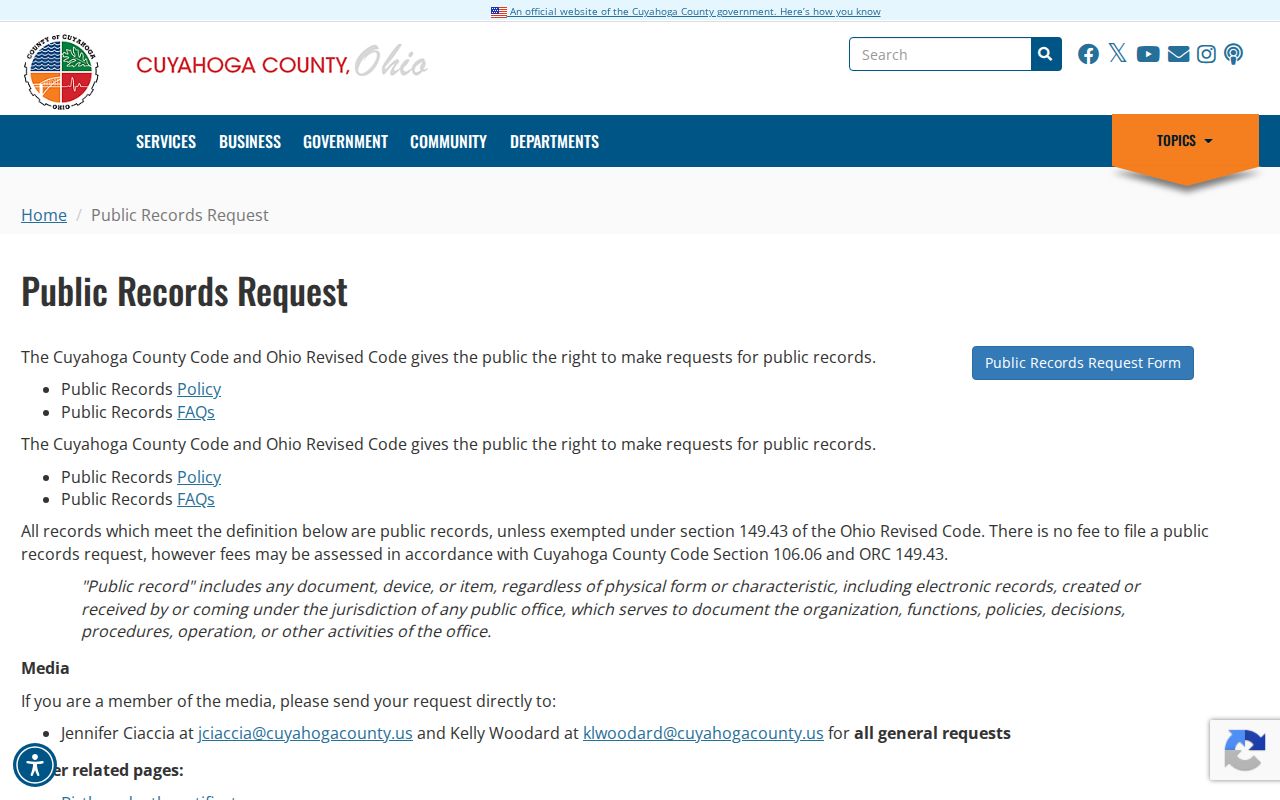
The portal is the archival fallback when a current roster, phone check, or court search cannot supply the historical release entry.
Cuyahoga County Release Record Law
Ohio Revised Code 149.43 governs public records held by state and local public offices, subject to exclusions. The office must promptly prepare records for inspection and make copies within a reasonable period. Nonexempt parts should be produced. When practical, redactions must be visible. A written denial must identify legal authority.
Public web display and agency retention are not the same. A person can vanish from the daily app while an underlying record remains with the Sheriff. The 2019 corrections schedule lists daily jail activity logs, including transfers and security events, for five years, but it does not expressly name every booking jacket, release record, roster entry, or photo. The custodian must identify the current schedule that applies. No unsupported retention term should be promised.
Juvenile, medical, victim, security, sealed, expunged, and supervision materials may be restricted. Ask for releasable portions and the cited exemption.
Cuyahoga Release Sealing Process
A jail exit does not seal a case. Ohio's current ORC 2953.32 measures many waiting periods from final discharge, which can occur after incarceration ends because supervision, costs, or other sentence terms may remain. Eligibility is detailed and excludes several offense classes. An old summary should not replace the live statute or court review.
Cuyahoga Common Pleas provides an application packet and local process. The Clerk's current fee list sets a $50 charge for a conviction motion to seal and/or expunge. Probation performs the statutory investigation, the prosecutor may respond, and the court decides. Municipal cases go to the court that handled them. The County Public Defender Expungements Division and local legal-aid route can help explain filing options.
Sealing limits public access and index references as the law directs. Expungement can require deletion or destruction by specified recipients, while a narrow state record may remain. Neither process rewrites history automatically on the day of release. A granted certified order and the source agency's current response are the sound basis for handling an older public result.
Find Cuyahoga County Released Inmates
Start with the last known custodian. A recent downtown county booking begins with the Sheriff app's daily roster, then the Release Desk and the correct court. A state-prison term begins with ODRC. A McDonnell CBCF or Common Pleas community-control placement begins with the court and County Probation. Federal BOP custody and ICE detention have separate national locators. VINELink supplements participating sources but is not a certified release record.
- Collect the full legal name, spelling variants, approximate age or birth date, booking date, agency, charge, and case number.
- Check the Sheriff app for current Cuyahoga County custody. No match is inconclusive because released people usually leave a current roster.
- Call the Release Desk at 216-443-6150 for a named CCCC status, especially after bond. Note when the answer was received.
- Read the Common Pleas docket for felony matters or the right municipal court for local cases.
- Search ODRC when transfer to state prison is possible. Read status and location, not just a date.
- Use VINELink for an event or future notification, then confirm with the reporting agency.
- Request the historical release or movement entry when the public tools do not preserve it.
A released person no longer belongs on a current-custody list. The absence is only a clue. The authoritative event can be release, transfer, escape, death, or a data mismatch, and each requires a different description. The Cuyahoga County 24-hour release page explains the local same-day fallback without inventing a public feed.
Cuyahoga ODRC Release Search
The ODRC Offender Search covers people sentenced to Ohio prison. It is not the Cuyahoga County jail archive. Search by ODRC number when known, or use a name and confirm the county, court, offense, and sentence. A result may show status, institution or supervision, admission and sentence information, and release or eligibility dates. Not every record has every field.
| Search or result field | Use |
|---|---|
| ODRC number | Best way to separate similar names. |
| Name and identity detail | Initial match that still needs case verification. |
| Status | Distinguishes incarceration, APA supervision, release, or another category. |
| Institution or supervision | Shows prison placement or community supervision context. |
| County and sentence | Connects the state record to Cuyahoga court history. |
| Expected release or parole eligibility | Forward-looking label that is not actual release proof. |
The official ODRC search form captured for this project shows the statewide entry fields.
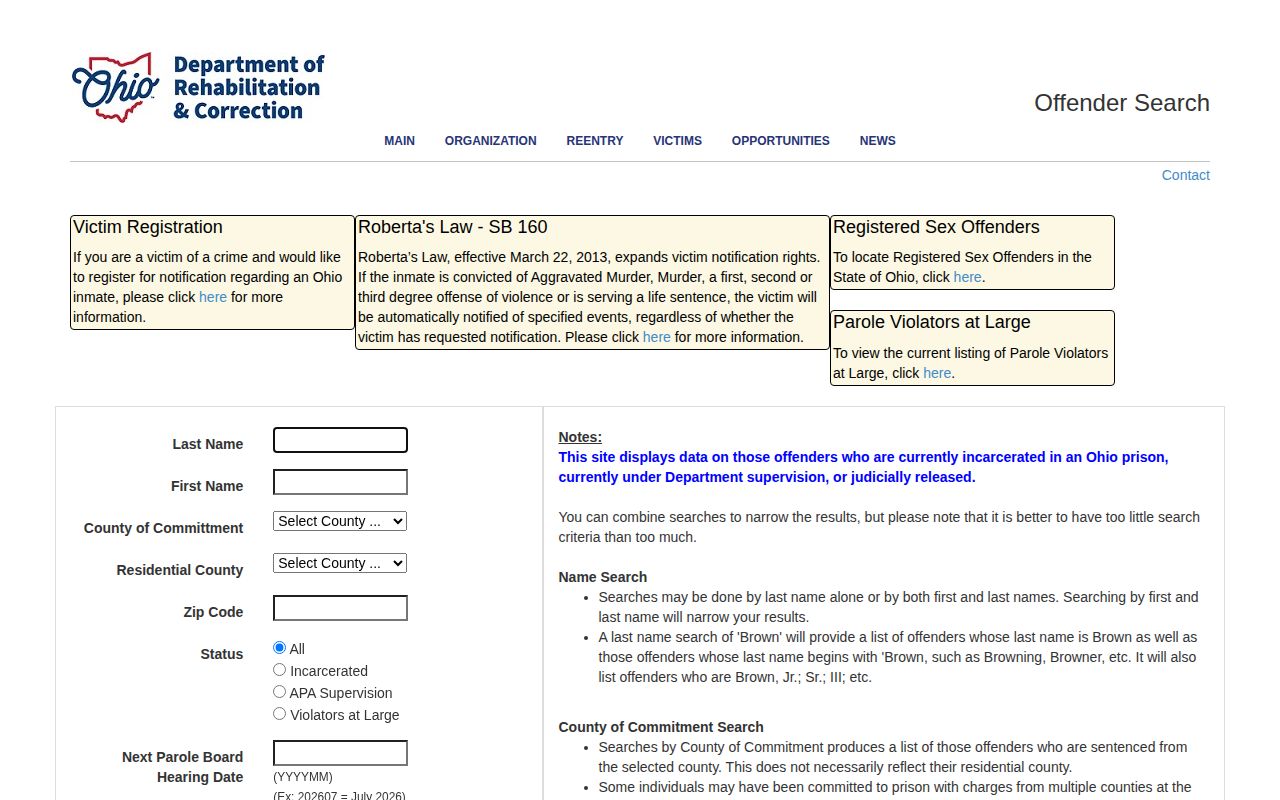
A status such as APA supervision can confirm that prison confinement ended while state control continues. A future expected or eligibility date requires a later status check.
Cuyahoga Release Court Search
Adult felony cases are filed in Cuyahoga Common Pleas. Its Web Docket accepts case-number or name searches and can show bond, journal entries, disposition, sentence, warrant, cost, and later sealing activity. The site warns that online data is not the official court record. Use it to identify an entry, then obtain a certified copy when proof is needed.
The county also has 13 municipal courts: Bedford, Berea, Cleveland, Cleveland Heights, East Cleveland, Euclid, Garfield Heights, Lakewood, Lyndhurst, Parma, Rocky River, Shaker Heights, and South Euclid. A Parma, Strongsville, Solon, Euclid, or Bedford Heights booking may be controlled by a municipal docket rather than the Common Pleas search. The Public Defender court directory links those systems.
The Common Pleas criminal docket portal is preserved in a successful project image.
A court order explains legal authority. It may not show the minute the jail opened the door or an unrelated hold. Pair the entry with the custodian's release or movement record.
Cuyahoga Release Pickup Hours
The Sheriff publishes a 6:00 a.m. to 6:00 p.m. window for dropping off and picking up prisoners. County-warrant bookings can occur at any time. These facts help with local logistics, but they are not a promise that all releases happen within that window or that a person will leave before 6:00 p.m.
After a bond payment is approved, the Clerk sends notice to the jail Release Desk. Posting bond starts or advances release processing. It does not complete the physical release. Staff may still check other cases, warrants, and holds. Call the Release Desk for the named person and ask when the status was entered rather than treating payment time as departure time.
Cuyahoga Release Transportation Support
The Sheriff's jail programming page documents resource backpacks for indigent or homeless residents leaving jail. They may include bus passes, hygiene items, clothing, shoes, and seasonal supplies. Two County Office of Reentry employees also work inside the jail, and jail liaisons connect residents to community services. Availability must be confirmed for the individual; no one should be promised a pass or a pack.
The downtown Justice Center sits near several GCRTA corridors. Transit service changes. The Waterfront Line has operated only for select stadium events under the current alert, so a static map should not be treated as a live travel plan. Check current GCRTA trip information at release time. The B-Line is a free downtown trolley route subject to its current schedule.
Cuyahoga Court Supervised Release
Common Pleas Court Supervised Release, or CSR, monitors people released before trial and may use electronic monitoring. It reviews county and suburban jail waiting lists. A person can therefore leave a jail through CSR while the criminal case remains active. This is not sentence completion, probation discharge, or dismissal.
The Pretrial Services record and Common Pleas docket explain the continuing court control. CSR is based in Tower II, and its published front-desk number is 216-443-2152. If a warrant or capias later appears, the court record may also explain why a planned community release changed.
Cuyahoga Release System Scale
The county says the Cuyahoga County Corrections Center manages more than 26,000 inmates each year. Strongsville separately reported 1,370 people held in its 24-bed municipal jail during 2024. Those figures are not a count of unique releases. They show why a search limited to the downtown county system can miss a short suburban booking.
The arresting agency, holding facility, and court may all differ. A city jail departure should be checked with that city and its charging court. A county satellite move remains Sheriff custody. A state transfer belongs to ODRC.
Cuyahoga Post-Release Reentry
Cuyahoga County has a concrete reentry layer. Two Office of Reentry employees work inside the jail, and county jail liaisons connect residents to services. The Office of Reentry provides local resource navigation and can be reached at 216-698-3437. These services do not prove a release, but they can support the transition after custody.
Supervision still needs its own check. County Probation manages court community control. ODRC's Adult Parole Authority manages state parole and post-release control. A released person can remain subject to conditions, violations, and later discharge. The Cuyahoga County parole and probation record explains how to verify each branch without confusing them.
Cuyahoga Federal Release Records
The BOP inmate locator covers federal Bureau of Prisons records, often including people released after 1982. A result can show a federal register number, release date, and location. “Released” means no longer in BOP custody. It does not rule out supervised release, state or county custody, or immigration detention. Federal pretrial detainees may be held in local contract beds before a BOP record applies.
The ICE Online Detainee Locator addresses current immigration detention, not a historical release archive. A missing result can reflect transfer, removal, data mismatch, or exit from ICE custody. No dedicated BOP prison or ICE detention center is mapped inside Cuyahoga County. Ask the Sheriff for the receiving destination after a suspected handoff.
Cuyahoga County Release Facilities
Cuyahoga's facilities do not share one release list. The county and satellite jails use Sheriff or municipal records. McDonnell CBCF uses the court and County Probation. Northeast Reintegration Center uses ODRC. The future Central Services Campus is expected to replace downtown CCCC in 2029, but it is not yet an operating or searchable jail.
- Cuyahoga County Corrections Center: Sheriff release entry, Release Desk, and court docket.
- Euclid Jail Annex: verify current satellite use and treat a move to CCCC as transfer.
- Bedford Heights Jail / Comprehensive Re-Entry Programming Center: first identify Sheriff or city booking authority.
- Parma Police Department Detention Center: use Parma and the charging municipal court.
- Strongsville City Jail: check local release versus transfer to another holder.
- Solon Detention Facility: use Solon and the arresting municipality's court.
- Judge Nancy R. McDonnell CBCF: confirm program completion and County Probation supervision.
- Northeast Reintegration Center: use statewide ODRC status and discharge records.
The planned 1,886-bed county campus on 72 acres in Garfield Heights remains a future project. Present release calls and requests must still go to the current custodian until an opening notice changes the system.