
Cuyahoga Released Mugshot Records
A booking photograph records appearance during a particular arrest or intake. It is not proof of guilt, present custody, or a later case outcome. When someone leaves the Cuyahoga County Corrections Center, the photograph may remain in the Sheriff’s underlying booking record even though the daily roster entry is gone. Administrative retention and public app display are separate matters.
Ohio does not categorically make every booking photograph secret. Sheriff-held photographs are analyzed under the Ohio Public Records Act, ORC 149.43, along with exemptions, redaction duties, retention, and applicable court orders. The office must provide releasable nonexempt portions and may charge only permitted actual copy or delivery costs. No blanket response deadline exists in days. A reasonable period depends on the request and records.
The photo should be tied to a unique booking. Ask for the full booked name, booking or inmate number if known, approximate booking date, arresting agency, court case, and the photograph associated with that event. A photo from ODRC, a registry, an older news story, or another arrest may show the same person but still be the wrong image.
Cuyahoga Mugshot Discovery Channels
Start with the custodian, not a general image result. Cuyahoga’s Sheriff app is a current-roster route, while the county request portal is the best official historical path for a specified county booking. City police hold their own municipal booking records. ODRC photographs relate to state-prison identification and should not be described as the downtown jail’s booking photo.
| Channel | Photo availability | How to access and interpret |
|---|---|---|
| Sheriff daily roster app | Not promised by the official county page | Check the current version while the person is listed; absence after release proves nothing about retention |
| County public-record request | Request the named booking photo | Give a narrow booking description and ask for electronic delivery |
| Municipal police or jail | Depends on the city record | Use Parma, Strongsville, Solon, or the other agency that made the booking |
| ODRC offender record | Individual records may include a photo | Treat it as a state-prison image; use status and dates to establish release |
| Chapter 2950 registry | May display a registrant image | Limited to people with a registration duty; not a general release-photo source |
| Official or news report | Event-specific | Check the date, caption, and originating agency; an older image may persist |
| Third-party aggregator | May copy stale or mislabeled images | Use only as a clue to an originating record, never as final confirmation |
VINELink is useful for participating custody events, but the research does not establish it as a durable Cuyahoga booking-photo archive. A federal BOP image is outside the county booking system, and immigration records follow a different custodian. Match the image source to the actual custody chain.
Cuyahoga Sheriff Mugshot App Limits
The Sheriff inmate-information page directs users to a mobile app and says it provides daily jail rosters, generic push notifications, news, and jail information. It does not promise that photographs appear, that departed records remain available, or that push notices are person-specific release alerts. No official browser-based released-photo gallery or 24-hour or 72-hour release-photo archive was found.
The official county page documents the app and daily-roster claim.
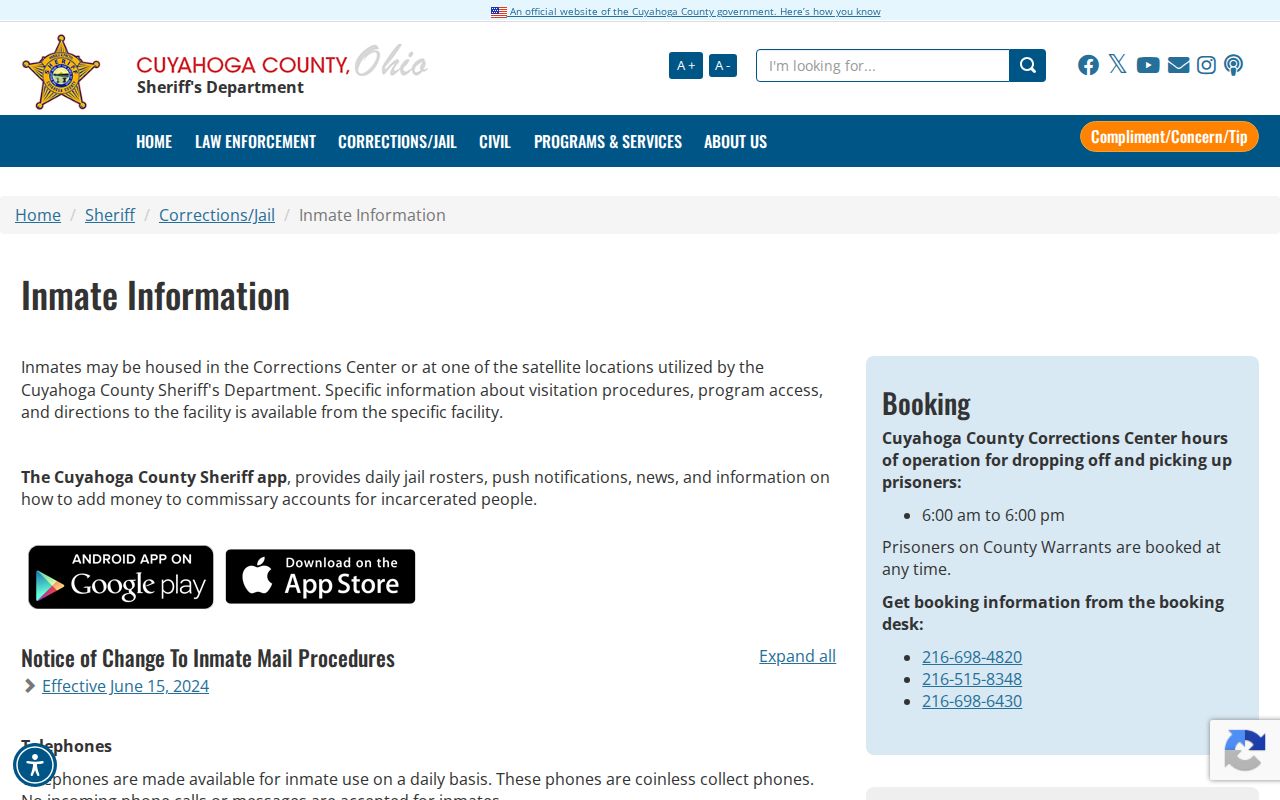
The captured page supports a current-custody check, but it does not establish photo coverage or post-release visibility.
Use the current Android Sheriff app listing or the County’s linked iOS Sheriff Connect listing to obtain the official app. Record the app version and access time if a photo is found. A live app feature can change, and an app-store illustration is not proof of what a specific record now contains.
For same-day custody context, the Cuyahoga County 24-Hour Release List explains why the app’s current roster is not a released-only feed. Use VINELink for a person-specific custody alert. Use a formal request when the photograph itself must be retrieved after departure.
Note: A roster disappearance is not proof of community release because transfer, escape, death, or another authority can explain the change.
Request Cuyahoga Booking Photos
The Cuyahoga County public-record request portal is the strongest official historical route for a Sheriff-held image. Filing is free. Request an existing booking photograph, not a new report or explanation. Narrow details reduce mistaken identity and help the records office locate the right booking without compiling a custom dataset.
- Identify the agency that made or held the booking. Use the Sheriff for a county booking and the city for a municipal booking.
- Describe the existing record as the booking photograph associated with the named person’s specified booking. Add a booking number, date range, arresting agency, and case number when known.
- Ask for electronic delivery. The county may charge actual copy or delivery cost under its policy, but submitting the request itself is free.
- If the office withholds or redacts material, ask for the legal authority supporting that decision and request all nonexempt portions.
- Match the returned photo to the booking number, date, and agency. Do not merge it with a different arrest or an ODRC prison image.
The official request page displays the County’s form, policy entry, and fee notice.
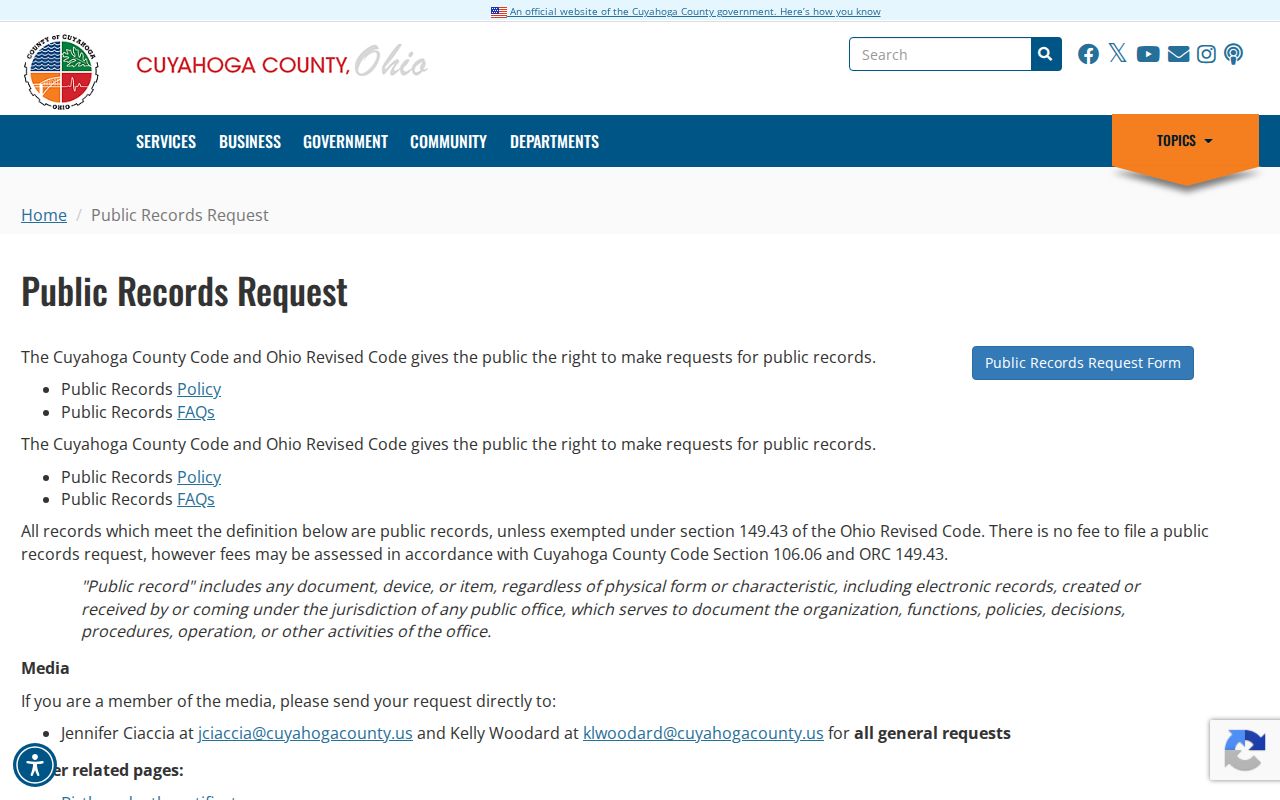
The request screen is the correct fallback when the daily app no longer exposes the named booking or image.
Ask for a code key if the related booking or release record uses unexplained abbreviations. The image gains value when connected to the booked name, booking number, arresting agency, booking time, charge and case number, and release or transfer event. The Cuyahoga County release-record search covers that broader custody chronology.
Other Cuyahoga Mugshot Sources
An ODRC individual record may contain an offender photograph. Search the ODRC Offender Search by number or name, confirm identity, and read status and release dates. The photograph identifies a state correctional record. It is not necessarily the booking image from the Cuyahoga County arrest that led to the case, and the state record should not be called a county-jail gallery.
Municipal bookings require the city source. A person held by Parma Police Department, Strongsville City Jail, Solon Detention Facility, or another local agency may never have had the relevant photograph in the Sheriff’s system. Request the image from the city and use the municipal court docket for the case context. A transfer into CCCC can create a second record held by a different office.
A Chapter 2950 registry can show an image only for a person who has a registration duty. It serves registry identification, not general inmate search. Official Sheriff, prosecutor, and police releases or a dated local-news report may retain an image after custody ends. Check the story date and caption. News may reuse an older booking or a non-booking photograph, so trace the image to its named source.
Commercial aggregators may preserve stale, mislabeled, or removed images. No commercial mugshot publisher or data broker is linked or endorsed here. If such a page points to an agency and booking number, return to the agency record. Provenance, or the image’s documented origin, matters more than how many copies appear online.
No Cuyahoga Released-Photo Gallery
Cuyahoga County advertises a daily roster in its Sheriff app, not a released-inmate photo archive. The County does not publish a guaranteed period during which a photo remains visible after a person leaves the roster. It also does not promise that every current roster entry has a photograph. Those limits are important because a current app observation can otherwise be mistaken for an official retention policy.
The records-request route is more durable. Ask for one named booking image and related booking or release identifiers. That request can be evaluated under current Ohio law, the applicable retention schedule, and any exemption or court order. If the person was booked by a city, address the request to that city instead of assuming the Sheriff owns the image.
The restriction does not change who owns the source record. Corrections to a Sheriff image or booking field belong with the Sheriff; ODRC controls its image; a city controls its booking; and a publisher controls its own copied page subject to law. Preserve the URL, access date, and booking identifiers when reporting an error.
Cuyahoga Mugshots After Expungement
Sealing and expungement concern court and related records under current Ohio Revised Code Chapter 2953. Eligibility and timing depend on the current statute and the person’s case. Final discharge is not merely the day the jail door opened. It can include completion of the sentence and other components relevant under the law. An old local summary should not replace the current Code.
Cuyahoga Common Pleas provides an expungement packet and process. The current Clerk fee schedule lists a $50 conviction sealing or expungement motion. The County Public Defender Expungements Division can be reached at 216-443-7580, and Legal Aid can be reached at 888-817-3777. Municipal cases must be filed in the court that handled them.
A granted order should be directed to the source offices that hold the affected records. It does not justify a broad claim that every copied image vanishes at once. Compare the order with the Sheriff, police department, court, ODRC, registry, or publisher response. Protected juvenile, medical, victim, security, and other exempt information also follows its own legal rules.
Ohio Mugshot Payment Restrictions
ORC 2927.22 targets a particular practice. A covered publisher or disseminator of criminal-record information may not negligently solicit or accept payment from the subject to remove, correct, modify, or refrain from publishing covered material, including an Ohio booking photograph. Each payment can be a separate offense, and civil remedies may apply.
The law does not ban all publication. It does not automatically make every Sheriff photo public, guarantee deletion, or force every outside publisher to remove an image at no cost. Sheriff disclosure still turns on ORC 149.43, exemptions, retention, and court orders. A source correction or sealing order should be addressed to the office or publisher that controls the record or page.
Do not pay a service based on a promise that it controls the official Cuyahoga record. Confirm the booking with the custodian, obtain any relevant court order, and make a precise correction or removal request to each actual source. Keep copies of the request and response. That creates a reliable record of what was asked and how the office applied current law.
Note: An old image can persist after custody ends, but it must not be treated as a current status or complete case history.
Public Record Search
Sponsored Results