
Cuyahoga Parole and Probation Compared
Parole and probation can both follow a person into the community, but they arise from different decisions. The Ohio Department of Rehabilitation and Correction’s Adult Parole Authority, known as APA, supervises state parole, post-release control, and certain other state release statuses. Cuyahoga County Common Pleas Court supervises a community-control sentence through its Probation Department. The court also runs Court Supervised Release for some people released before trial. That pretrial program is not a completed sentence and is not state parole.
The distinction controls the search. An ODRC record can show that someone left an Ohio prison for APA supervision. A Common Pleas docket can show a community-control sentence, probation violation, capias, termination, or successful completion. For a municipal case, search the court that handled the charge. The county has several municipal courts, so a Common Pleas search alone will not cover every local probation matter.
| Status | Who orders it | Where to verify |
|---|---|---|
| Parole | Release under state authority after a prison term | ODRC Offender Search and APA records |
| Post-release control | State supervision tied to an Ohio prison sentence | ODRC status, release detail, and supervision fields |
| Probation or community control | Cuyahoga County Common Pleas or the proper municipal court | Sentencing entry and later court docket events |
| Court Supervised Release | Common Pleas pretrial order | Case docket and Pretrial Services |
- Parole
- Conditional release from a prison term under state supervision.
- Probation
- A court-ordered community sentence, often called community control in Ohio.
- Post-release control
- APA supervision that follows certain Ohio prison sentences.
- Discharge
- The formal end of the relevant supervision term, not merely release from a building.
Check Cuyahoga Post-Release Supervision
The official person-level source for Ohio parole and post-release control is the ODRC Offender Search. Its form permits a status filter for APA Supervision and a residential-county filter for Cuyahoga. It also offers Released, Incarcerated, and Violators at Large choices. A residential county or ZIP code is only the last recorded address for some APA records. It may lag and is not proof of where the person is now.
- Search by ODRC number when known. Otherwise, enter the exact name and compare the date of birth, court, offense, and sentence chronology.
- Choose APA Supervision for a state-supervision check. Use Cuyahoga as the residential-county filter only as a way to narrow results.
- Open the matching record. Read status, supervision start, period of supervision, APA office, release or parole detail, and ODRC number together.
- For probation, open the Common Pleas criminal docket or the municipal court that handled the case. Read the sentencing entry and all later probation events.
- Ask the Clerk for a certified entry when formal court proof is needed. Contact APA through its official state route if an ODRC office label or status needs confirmation.
An institution name may remain in the ODRC record as sentence or history context even while the current status says APA supervision. The status and supervision fields resolve that apparent conflict. For the underlying release chronology, compare the state record with the court entries and the county release routes described on the Cuyahoga County released-inmate search.
The ODRC APA Field Services page shows the state agency responsible for community supervision.
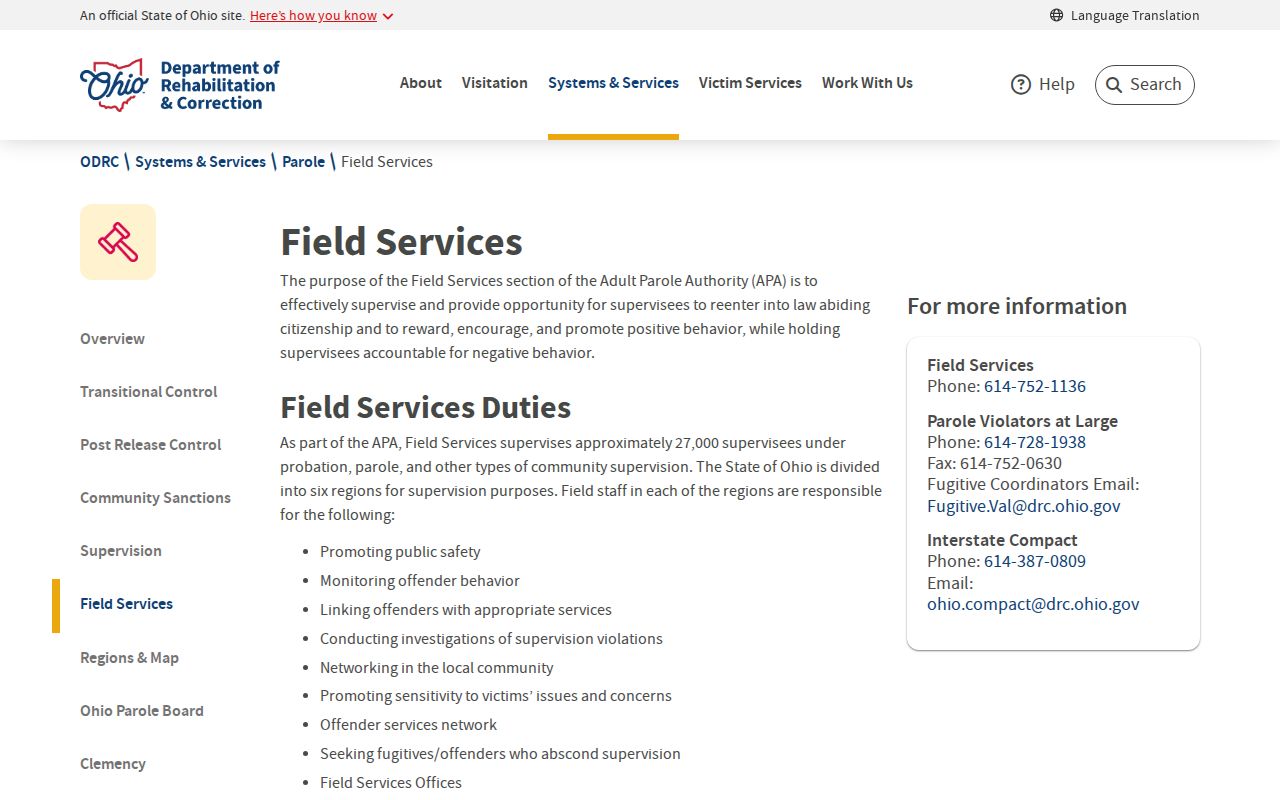
The captured state page helps identify the correct supervision system before a person-level ODRC search is interpreted.
Cuyahoga Supervision Offices and Records
ODRC records can identify units with labels such as “CLEVELAND 7.” The research did not find a dependable public directory that maps every numbered unit to a current street address and direct phone. Do not guess from an old listing. Preserve the exact office label shown in the record, then use the APA Field Services contact route or ODRC Central Records to confirm it.
Common Pleas Pretrial Services
Court Supervised Release front desk
Justice Center, Tower II
Phone: 216-443-2152
Official Pretrial Services information
The front desk is relevant only to Common Pleas pretrial supervision. A post-sentence community-control question belongs with the Probation Department and the criminal docket. State parole and post-release control remain APA matters. Probation and parole proceeding files are excluded from the public-record definition in ORC 149.43(A)(1)(b), so the public should not expect a complete supervision case file even when the basic status is visible.
Conditions of supervision provide useful context. An APA-supervised person remains under the releasing authority, must keep APA informed of a residence, and must report an arrest by the next business day after release from custody. Exact conditions depend on the person’s order. A public status screen should not be treated as the full set.
Note: A docket web page is a convenient lead, while the Clerk’s certified journal entry is the formal court record.
Cuyahoga Parole Absconders and Warrants
ODRC’s Violators at Large list, often shortened to VAL, is a distinct statewide search. A VAL status means the person was released under APA supervision and is now wanted for an alleged violation or absconding. Absconding means leaving supervision or failing to report as required. It does not mean the person is presently back inside a prison.
The list can be narrowed by a last recorded residential county, including Cuyahoga. That field is not a live location. ODRC warns the public not to approach a listed person, and law enforcement must verify a warrant through LEADS or NCIC. Those are official law-enforcement systems. For a county warrant or capias, the Cuyahoga Clerk directs callers to the Sheriff’s Warrant Division at 216-443-6100. A warrant may delay a planned release or lead to an immediate handoff into another matter.
The official ODRC VAL page documents the statewide absconder route and its safety warning.
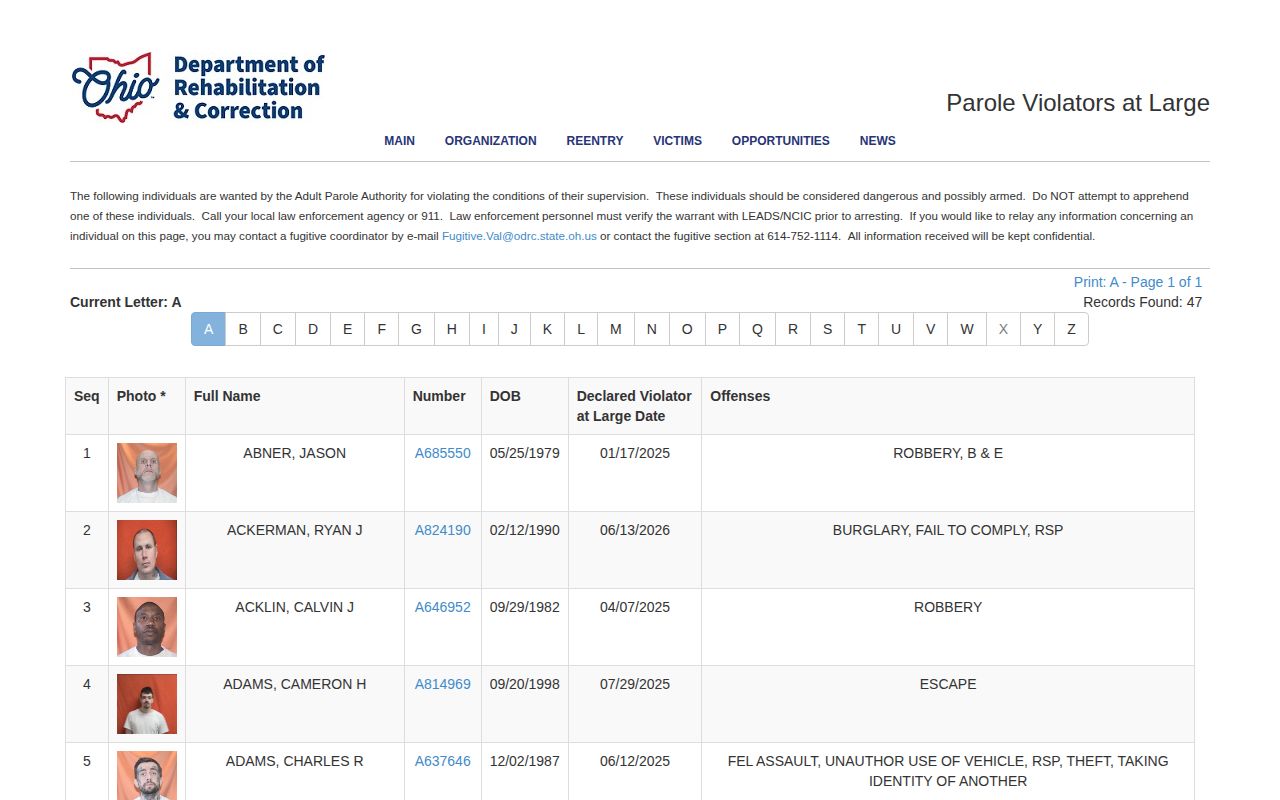
The image shows why a Cuyahoga filter is a search aid, not proof of present residence or current incarceration.
Cuyahoga Probation and Parole Changes
Conditions and violations affect release status in different ways. An APA violation may lead to a warrant, revocation process, return to custody, or a new supervision decision. A probation violation is handled in the court that ordered community control. The docket may show a notice, capias, hearing, modification, termination, or later journal entry. None of these labels should be inferred from a person’s absence from a roster.
VINELink is designed for custody-event notification through participating agencies. It may report county or state custody events, but it does not replace the supervision record or court order. A supervision violation is not necessarily a new booking, and a VINE alert does not describe the full reason for an APA or probation decision. Confirm a custody event with the holding agency and confirm supervision through APA or the court.
At a high level, supervision can require reporting, address updates, compliance with court or APA directives, and notice of an arrest. Terms vary by order and sentence. Do not assume that two people with the same broad status share the same restrictions. If a status is unclear, use the record number and ask the office that created the field.
Cuyahoga Reentry After Supervised Release
Cuyahoga County has a concrete local reentry layer that is separate from supervision enforcement. Two County Office of Reentry employees work inside the jail, and jail liaisons connect residents with community services. The Sheriff also documents resource backpacks for indigent or homeless people leaving custody. Supplies may include a bus pass, clothing, hygiene items, shoes, and seasonal goods. Availability is not guaranteed for every release.
Cuyahoga County Office of Reentry
4261 Fulton Parkway
Cleveland, OH 44144
Phone: 216-698-3437
Email: cuyahoga-reentry@jfs.ohio.gov
Reentry resources
The Office of Reentry provides navigation and support. It is not the office that changes an APA status, probation order, or court docket. Use it for local service connections while directing record questions to the state, Sheriff, Clerk, or court that owns the relevant record. This separation keeps a support request from being mistaken for legal supervision verification.
Note: The Office of Reentry says it aims to respond within 48 hours, but urgent supervision questions belong with the supervising authority.
Cuyahoga Supervision Discharge Records
Supervision ends through a formal action, not merely the passage of an expected date. For APA, look for an updated ODRC status and release or supervision detail indicating discharge. For community control, read the court’s termination or successful-completion entry. A closed jail booking proves only that physical custody ended. It does not establish that parole, post-release control, probation, or a pretrial order also ended.
A fully discharged or inactive ODRC record differs from APA supervision. Likewise, a Common Pleas sentence entry can set a community-control term, while a later entry records a violation, change, or completion. When legal proof matters, obtain the official record from ODRC or a certified entry from the Clerk. Keep the ODRC number or case number with the request to avoid mixing people with similar names.
Public access has limits. ORC 149.43 requires Ohio offices to provide nonexempt public records promptly for inspection and copies within a reasonable period, but it excludes probation and parole proceeding files. A visible status, court journal entry, or releasable state record can still establish the basic chronology. Ask the office to cite the legal authority for any denial or redaction.
Public Record Search
Sponsored Results