
Cuyahoga VINELink Release Coverage
The Ohio Attorney General identifies VINE and VINELink as Ohio’s custody-notification service. Its official materials say participating Ohio county jails, the Ohio Department of Rehabilitation and Correction, and the Department of Youth Services can report events. For an adult Cuyahoga County search, that means a Cuyahoga County Corrections Center record and an ODRC prison record may both appear, but they remain separate records from separate custodians.
County-jail events include General Release, Transfer, Escape, and Death. ODRC notifications can include general release, prison transfer, parole revocation or return, release from parole, Transitional Control Review, and certain parole or eligibility events. Do not turn every change into “released.” Read the event label, agency, and event date as a group.
- VINE
- The notification network that receives participating-agency custody events.
- VINELink
- The public search and registration interface used to find a record and request alerts.
- General Release
- An end to custody reported by that source agency; another hold or custody system can still exist.
- Transfer
- A move to another custodian or location, not a return to the community.
Search Cuyahoga VINELink Records
Begin with enough detail to identify one person. The official workflow anticipates a name or offender number. The live interface may offer additional filters, and those fields can change. A state prison number is useful for an ODRC record, while a county-jail result must be tied to the reporting jail.
- Open Ohio VINELink and make sure Ohio is selected.
- Enter the name or identification details requested by the current form. Try a spelling variant if the first search is empty.
- Compare name, ID, age or birth information where shown, and source agency. Do not choose a record on name alone.
- Open the matching record and read the custody status or event together with the agency and event date.
- If the result is missing or unclear, contact the agency that should hold the record. Use the Sheriff for a county booking and ODRC for a state-prison record.
The Ohio VINELink person-search screen is the official entry point documented in the image manifest:
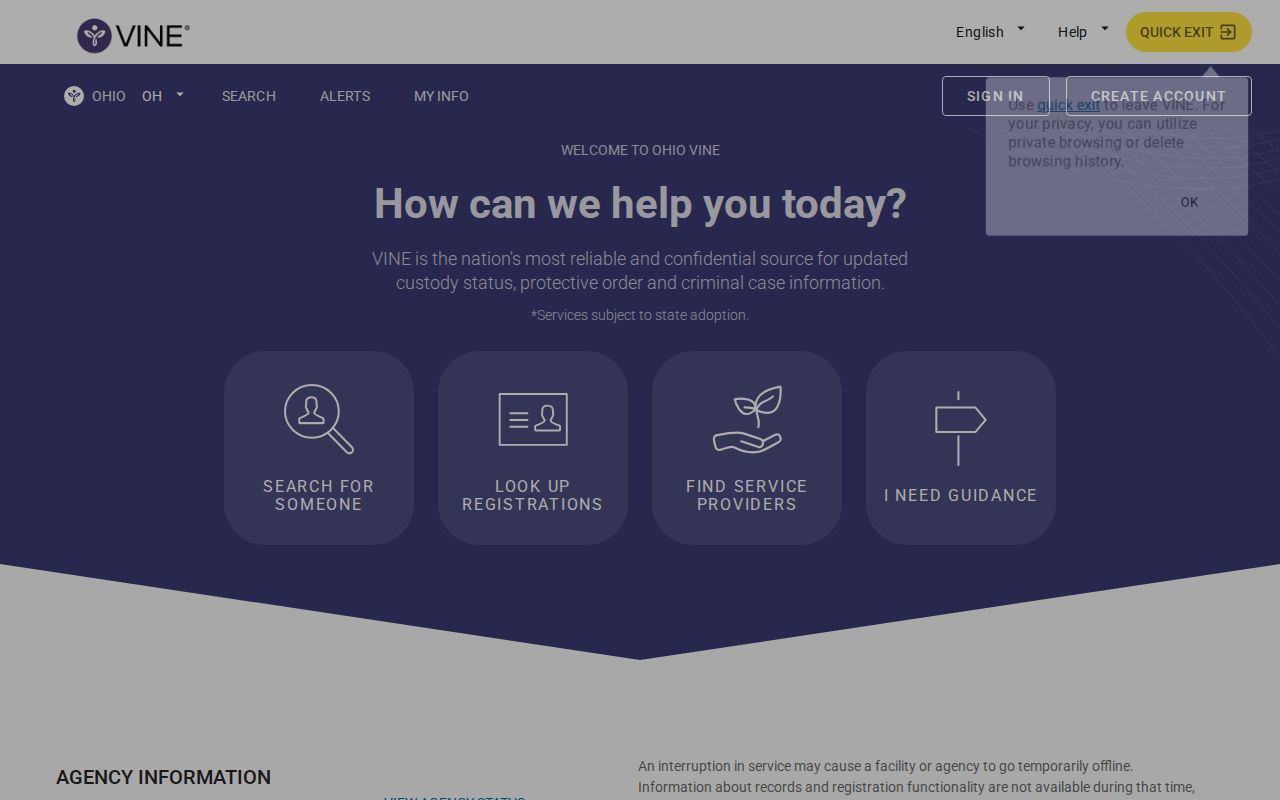
The screen supports a specific-person check. Exact filters and result labels should be read from the live form rather than assumed from an older screenshot.
Note: No official retention period was found for released VINELink search results, so use the source agency for an old event.
Cuyahoga VINELink Release Fields
VINELink is a status and notification service, not a certified release instrument. Its value comes from the combination of identity, source, status, and event data. A county record relates to the reporting jail. An ODRC record relates to state custody or supervision. The service does not merge those histories into one legal chronology.
| Field or label | How to read it |
|---|---|
| Name and person ID | Use them with age or birth details where shown to separate similar names. |
| Reporting agency | Identifies whether the event came from CCCC, ODRC, or another participating custodian. |
| Custody status | Describes the current status supplied by that agency at the time of its update. |
| Event type | Separates general release from transfer, escape, death, or an ODRC supervision event. |
| Event date | Places the reported change in time but does not replace a certified source record. |
| Notification options | Shows the contact routes currently offered for future changes on that record. |
An ODRC result may also include status, institution or supervision, sentence facts, and release or eligibility dates in the state offender system. Those are ODRC fields, not guaranteed VINE fields. If a date is forward-looking, do not call it an actual release. Confirm after the date through the state record.
Register Cuyahoga Release Alerts
Register while the matching person is in custody. That makes VINE useful for a future release, transfer, or other reported change. Registration is less suited to reconstructing a departure that happened long ago. Choose only the record whose identifiers and agency match.
- Open the matching in-custody record and choose the registration or notification option offered by the current interface.
- Select phone, email, SMS, or TTY when available. More than one contact route may be registered.
- For telephone registration, create the four-digit PIN required by the Ohio instructions. Email registration does not use that phone PIN.
- Complete the prompts and keep the PIN private. When an automated call arrives, listen, enter the PIN, and then press the pound sign to acknowledge it.
- Confirm the event with the reporting jail or ODRC. An alert is a prompt to verify, not the final custody record.
The Ohio instructions say acknowledgment stops repeat automated calls, while a custody change produces one email. If the PIN is lost or the service has an issue, current VINE support lists 1-866-277-7477 for multilingual help at any time.
Choose the source record with care before adding contacts. A county-jail registration follows events sent by that jail, while an ODRC registration follows the state record. Registering on one does not guarantee notice from the other. If the person is transferred, inspect the event, identify the receiving agency, and register again when the new participating record offers that option.
Ohio VINE Release Notification
Ohio adds a clear state layer to VINELink. The Attorney General publishes coverage and registration instructions, while Ohio law provides requested victim notices in qualifying cases under ORC 2930.16. The statutory notice process is a victim-rights mechanism. It is not a public inmate locator and should not be confused with a general VINELink search.
The Ohio Attorney General’s victim-notification page documents VINE coverage and registration:
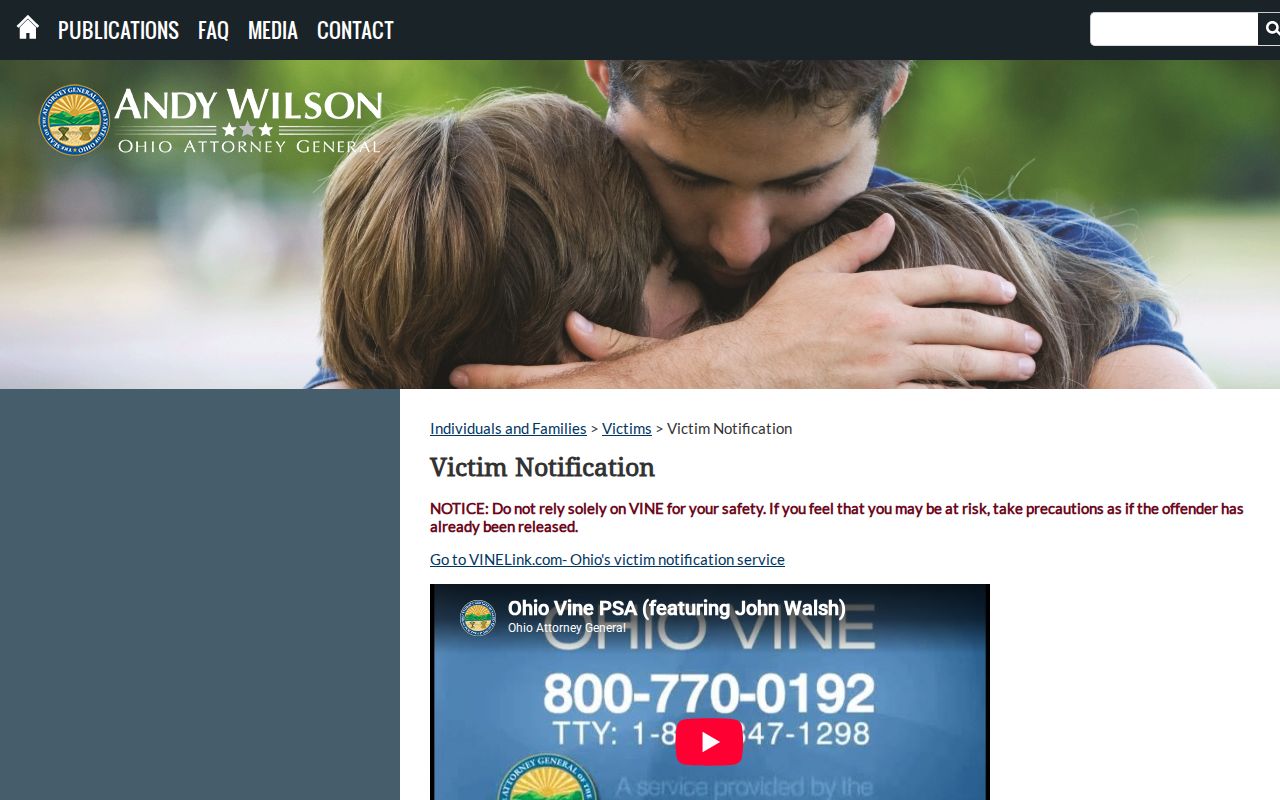
The state source also warns users not to rely on VINE alone. For personal safety, act as though release may already have occurred and confirm through the custodian.
Note: Ohio statutory victim notice and public VINELink registration can overlap, but they are distinct routes with different legal purposes.
Cuyahoga County Versus ODRC
A CCCC event ends or changes custody reported by the county jail. It does not answer whether ODRC, another county, a municipal jail, or another authority took custody next. Call the Sheriff Release Desk at 216-443-6150 when a recent CCCC event needs direct confirmation. A narrow public-record request can seek the existing release or movement entry for historical proof.
An ODRC event concerns Ohio’s state prison or supervision system. Search the ODRC Offender Search by number when possible, then read status, institution or supervision, and date labels together. “Expected Release Date/Parole Eligibility Date” is not always an actual discharge. Recheck the record after the date or contact ODRC when the distinction matters.
| Record source | Correct use | Not proof of |
|---|---|---|
| Cuyahoga jail VINE event | Reported change from a participating local jail record. | Release from state, federal, or immigration custody. |
| ODRC VINE event | Reported state prison, parole, or supervision change. | A Cuyahoga jail release time. |
| Sheriff roster | Current county custody lead. | A historical release or transfer record. |
| ODRC offender detail | State status, custody or supervision, and applicable dates. | A complete county booking history. |
For a Cuyahoga municipal booking, the reporting agency can be a city rather than the Sheriff. Parma, Strongsville, or Solon custody must be matched to that city’s detention record and municipal court. A transfer from a city jail to CCCC is not community release. VINELink can help flag a change only when the relevant agency participates and supplies the event.
Cuyahoga Registries Are Not Release
Ohio’s sex-offender search has a limited statutory purpose. It applies only to people with a Chapter 2950 registration duty. A matching public registry record may show that a person reports after release, but it cannot establish when or how the Cuyahoga jail released that person. Most people released from custody will not appear in the registry.
The violent-offender database created under Sierah’s Law is different. Ohio law makes the BCI database law-enforcement-only and not a public record, though certain enrollment materials held by a sheriff may be available after protected details are removed and subject to court limits. Neither registry is a substitute for VINELink, the Sheriff’s release entry, or an ODRC status.
Keep the question narrow. VINELink reports participating custody events. A registry reports a legal registration duty. A court docket reports judicial action. Mixing those sources can turn a valid fact into a false release conclusion.
Cuyahoga VINELink Release Limits
VINELink depends on participating-agency data, so updates can lag. A blank search can result from spelling, identity mismatch, agency coverage, or the age of the event. No match does not prove that a person was never booked or has been released. Try careful variants, confirm the custodian, and use the agency’s record process.
Federal Bureau of Prisons, ICE, and U.S. Marshals custody are outside Ohio VINE coverage. Use the BOP inmate locator for federal sentenced custody and historical release information. Use the ICE Online Detainee Locator for current immigration detention under its rules. “Not in BOP custody” does not rule out county, state, immigration, or supervision status.
Identity errors are another limit. Compare middle name, age or birth details, offender number, case jurisdiction, and chronology before choosing a result. If a source appears wrong, save the page and access time, then contact the agency that created the disputed field. The Clerk cannot revise a Sheriff custody event, and the Sheriff cannot change ODRC source data.
A court docket can explain the order behind a jail departure but not the jail’s physical processing time or an unrelated hold. For a full person-specific path across local, state, court, and federal systems, use the Cuyahoga County released inmate search.
Note: Save the reporting agency, event label, event date, and access time before asking the custodian to verify a VINE result.