
Cuyahoga Projected and Actual Release
A projected date estimates when a sentence or release process may reach a stated point under the facts then in the record. An actual release is the completed custody event. The two can diverge. ODRC may calculate a future date for an Ohio prison sentence, yet discipline, sentence changes, parole action, a detainer, or another lawful event can alter what happens. A county jail may receive a court order while processing and hold checks are still underway.
A pretrial detainee generally has no fixed release date because custody depends on bond, later hearings, case disposition, and other holds. A county-sentenced person’s calculation rests on the sentencing journal entry, lawful jail-time credit, and the Sheriff’s calculation. A state prisoner’s dates are computed within ODRC’s sentence system. Never transfer a state-prison credit rule to a local jail stay without legal authority.
| Date or event | What it means | How to confirm |
|---|---|---|
| Expected release date | A conditional ODRC calculation based on the current record | Read exact date label, sentence detail, and current status |
| Parole eligibility | The first possible consideration point for a qualifying sentence | Check ODRC release detail and Parole Board action |
| Court release order | Legal authority that may start jail processing | Compare the docket with the holding agency’s release entry |
| Actual release | The completed departure or handoff event | Use an agency status, release entry, or records response |
Find Cuyahoga Projected Release Dates
Start with the last confirmed custodian. A person who left the Cuyahoga County Corrections Center for an Ohio prison was transferred, not released to the community. That person belongs in the ODRC Offender Search. A current county booking belongs with the Sheriff and court. Parma, Strongsville, Solon, and other municipal custody must be checked through the controlling city jail and municipal court.
- Collect the full name, date of birth or age, ODRC or booking number, court case number, and last known custodian. Use the ODRC number when available.
- For an Ohio state prisoner, search ODRC and open the exact matching record. Copy the date label rather than shortening it.
- Read status, institution or supervision information, county of commitment, offense, admission data, sentence structure, and release or parole details together.
- For a Cuyahoga jail sentence, read the sentencing journal entry and jail-time credit, then ask the Sheriff’s Release Desk or records office about the jail calculation.
- For pretrial custody, follow bond and later court orders instead of inventing a sentence end date. Check for warrants, capiases, and other holds.
- After the future date, check the actual status and request a release or movement entry if the public record is unclear.
The documented ODRC record example shows the date and status labels that must be read together.
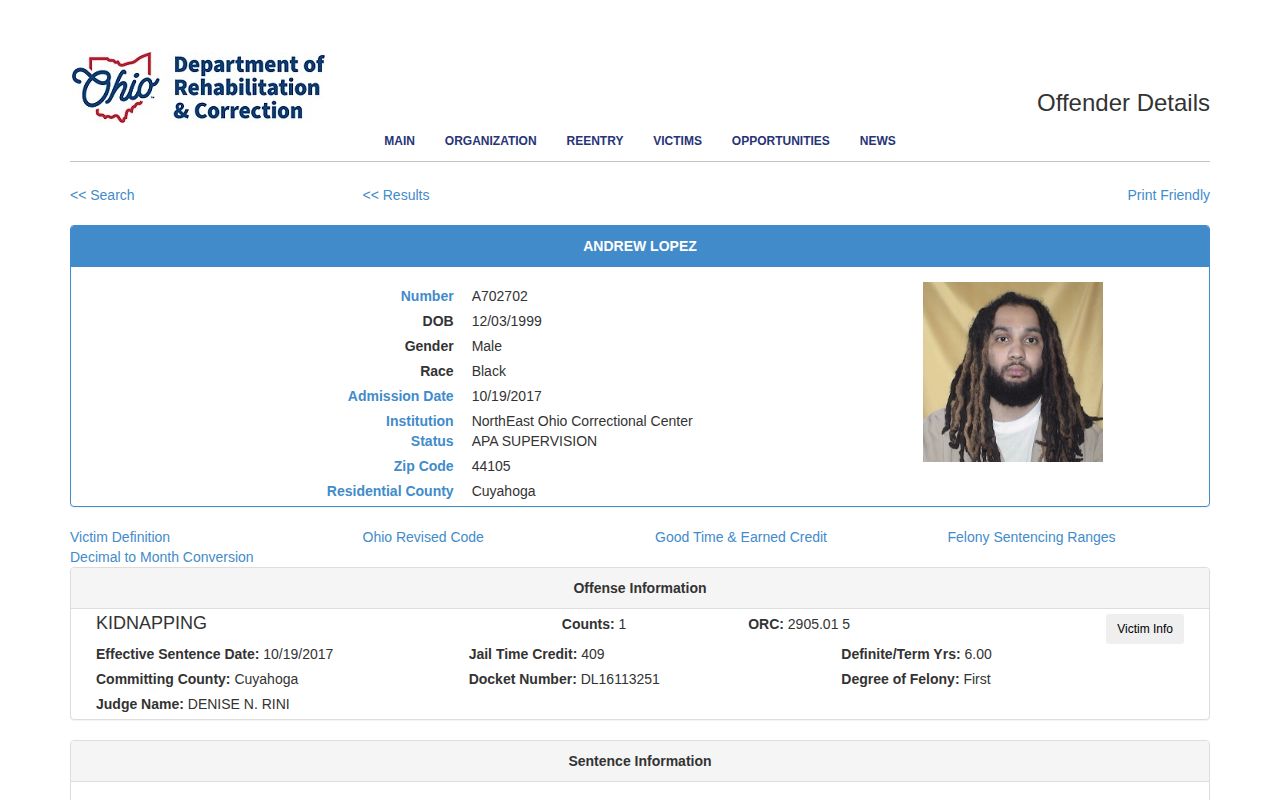
The example demonstrates why a date field cannot be separated from current incarceration or APA-supervision status.
For a named county-jail release and its historical record, the Cuyahoga County released-inmate lookup explains the Sheriff, docket, VINE, and public-record request chain.
Cuyahoga ODRC Date Label Explained
ODRC uses the label Expected Release Date/Parole Eligibility Date. Its definitions describe this as a projected release date or a date pending parole consideration. Those are not the same promise. Release or parole detail may further use POA for the earliest date of release to APA supervision and PRD for Projected Release Date. Copy whichever label appears on the individual record.
Sentence type supplies the meaning. A definite sentence may have a calculated end subject to lawful changes. An old-law or life sentence may reach parole eligibility without a guarantee of release. A Reagan Tokes non-life indefinite sentence has a minimum and maximum structure. The future field must therefore be paired with sentence terms, court entries, and any Parole Board information.
- POA
- The earliest stated date for possible release to Adult Parole Authority supervision.
- PRD
- A projected release date recorded in the state system; it can remain conditional.
- Parole eligibility
- A point when qualifying release may be considered, not an order to release.
- Actual status
- The record’s current statement of incarceration, supervision, release, or discharge.
Note: A future ODRC date should be rechecked after it passes because the later status shows whether release actually occurred.
Cuyahoga Release Credit Rules
Ohio does not have a universal rule that every prisoner serves 85 percent. Beginning April 4, 2024, ORC 2967.194 permits eligible confined people to provisionally earn one or five days per completed month of productive participation, depending on the statutory category. Certain program completions can produce additional credit. The ordinary participation and completion credits under the relevant division are capped in aggregate at 15 percent of the stated term.
That cap is not a promised reduction. The statute excludes mandatory or nonreducible terms and lists serious, life, violent, and sexually oriented offense categories. Eligibility, actual participation, jail-time credit, consecutive or concurrent terms, judicial release, transitional control, parole, indefinite sentencing, and other sentence facts can all change the calculation. Former ORC 2967.193 addresses the transition for earlier earned-credit periods.
County jail time follows a separate path. The sentencing journal entry, statutory jail-time credit, and Sheriff calculation govern a local Cuyahoga sentence. No public Cuyahoga good-time calculator or county weekend-release rule was located. The ODRC 15-percent framework should not be used to perform local jail arithmetic.
Cuyahoga Indefinite Sentence Dates
Under ORC 2967.271, a Reagan Tokes non-life indefinite sentence generally carries a presumption of release at minimum-term expiration or an applicable earned-early-release date. ODRC may rebut that presumption at a hearing based on statutory institutional or security grounds. Continued confinement cannot extend beyond the maximum term under that framework.
The minimum or presumptive date is therefore not an unconditional appointment. Read the maximum term and any hearing outcome. For specified old-law and life categories, ORC 2967.13 controls parole eligibility with different rules and exclusions. Life without parole and specified Chapter 2971 terms do not become eligible.
If parole is denied, OAC 5120:1-1-10 allows a later hearing or a PRD. A board-set PRD is discretionary, may be rescinded, creates no entitlement, and is recorded in minutes. The ODRC record and any board decision must be read with the sentencing court’s entry.
Cuyahoga Release Dates Can Change
A projected date changes when one of its legal or factual inputs changes. That does not always mean the old value was an error. It may have been accurate under the record then available. Keep a dated copy of a result when tracking changes, and ask ODRC or the jail to explain the current field instead of doing independent sentence arithmetic.
| Factor | Possible effect | Record to check |
|---|---|---|
| Earned credit or its loss | May move an eligible calculation earlier or later | ODRC computation and ORC 2967.194 eligibility |
| Jail-time credit | Changes credited confinement against the sentence | Sentencing and later court journal entries |
| Consecutive or concurrent terms | Changes how multiple terms are aggregated | Judgment entry and ODRC sentence detail |
| Detainer or warrant | May cause a handoff instead of community release | Holding agency and receiving authority |
| Resentencing or reversal | Changes the lawful sentence basis | Court docket and certified entries |
| Parole or indefinite-sentence action | Can defer, condition, grant, or rescind a date | ODRC status, board minutes, and hearing result |
A transfer from CCCC to Northeast Reintegration Center or another ODRC institution is not a county release. Likewise, an APA supervision start marks release from prison into state control, not full discharge. A federal or immigration hold must be checked with the relevant receiving system.
Request Cuyahoga Release Date Records
A public search may leave a calculation unclear. For an Ohio prison term, the ODRC Bureau of Sentence Computation is the state unit tied to sentence calculations. Preserve the ODRC number, the exact label and value displayed, the access date, and the court case before asking ODRC to confirm its record. A question about what a judge imposed belongs with the sentencing court, while a question about the state’s current calculated field belongs with ODRC.
For a Cuyahoga County jail record, describe the existing information sought through the County public-record request portal. Useful items can include the commitment and release record, movement entry, jail card, or releasable calculation fields associated with a specified booking. Include a narrow date range, booking or case number, and electronic delivery preference. Filing is free, though actual copy or delivery costs may apply.
ORC 149.43 requires prompt preparation for inspection and copies within a reasonable period, subject to exemptions. It does not set one fixed number of days for every request. The office must provide nonexempt portions and, for a written request, explain a denial with legal authority. Ask for the field as kept in the ordinary course rather than asking staff to create a new projected date.
A records response must still be matched to the right system. The Sheriff cannot correct an ODRC computation, ODRC cannot rewrite a judge’s journal entry, and the Clerk does not control the time a jail completes release processing. Direct each disputed field to its creator and preserve the responses as a dated chronology.
When two records conflict, ask each custodian what date its field reflects. The answer may separate a calculated sentence milestone from physical departure or transfer.
Confirm Cuyahoga Actual Release Dates
After the projected date, return to the system that held the person. For ODRC, look for a non-incarcerated status, supervision start, release detail, or discharge information. For Cuyahoga County Corrections Center, use the Sheriff inmate-information route, call the Release Desk at 216-443-6150, and request the release or movement entry when historical proof is needed. For municipal custody, use the responsible city and municipal court.
Ohio VINELink can provide custody-event alerts for participating county and ODRC records. It is a notification tool, not a certified sentence calculation or release record. The VINELink Check can help track a pending event, but the Sheriff, ODRC, or receiving authority remains the source for confirmation.
The Cuyahoga Common Pleas criminal docket can explain the authority for release, jail-time credit, judicial release, or a changed sentence. It may not show the time staff completed release processing or whether a separate hold caused a transfer. Combine the court entry with the status-bearing custody record. That produces a far stronger chronology than relying on a date field alone.
Public Record Search
Sponsored Results